
Carpenter resume example
Writing a Carpenter resume requires highlighting your technical skills, experience with various materials, and ability to read blueprints. Focus on your accomplishments and the impact you've made in previous roles. Use specific metrics to demonstrate your capabilities.
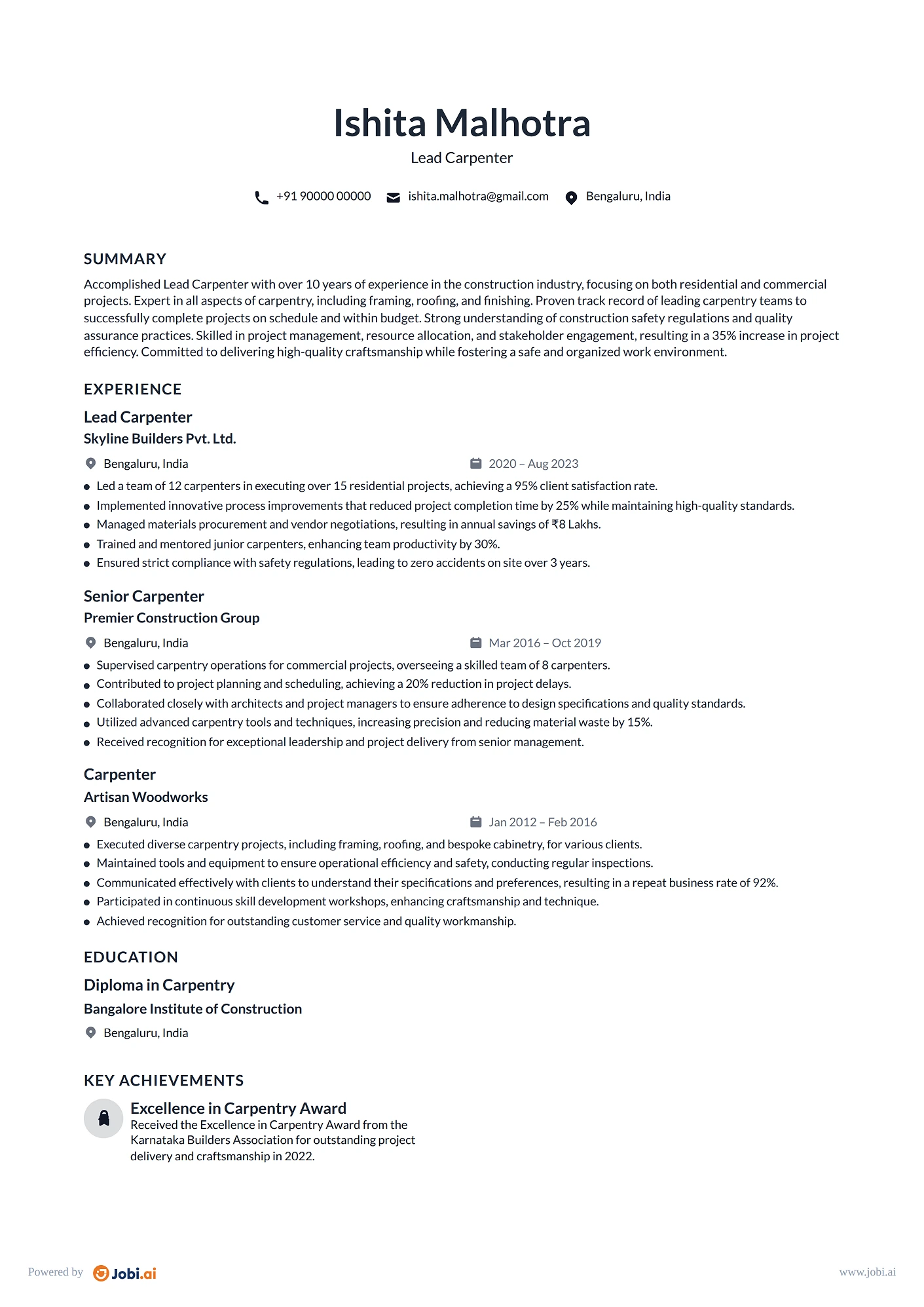
Ishita Malhotra
- Led a team of 12 carpenters in executing over 15 residential projects, achieving a 95% client satisfaction rate.
- Implemented innovative process improvements that reduced project completion time by 25% while maintaining high-quality standards.
- Supervised carpentry operations for commercial projects, overseeing a skilled team of 8 carpenters.
- Contributed to project planning and scheduling, achieving a 20% reduction in project delays.
Sign in to open this example in the editor, then replace the details with your own.
Copy-ready content for your Carpenter resume
Steal these as a starting point, then replace every number with evidence from your own work. Click to copy.
- Constructed and installed frameworks, structures, and fixtures using wood and other materials.
- Interpreted blueprints and building plans to meet client specifications and ensure project accuracy.
- Collaborated with contractors and clients to deliver projects on time and within budget.
- Trained and supervised junior carpenters, improving team productivity by 30%.
- Implemented safety protocols that reduced on-site accidents by 25%.
Example resumes to start from
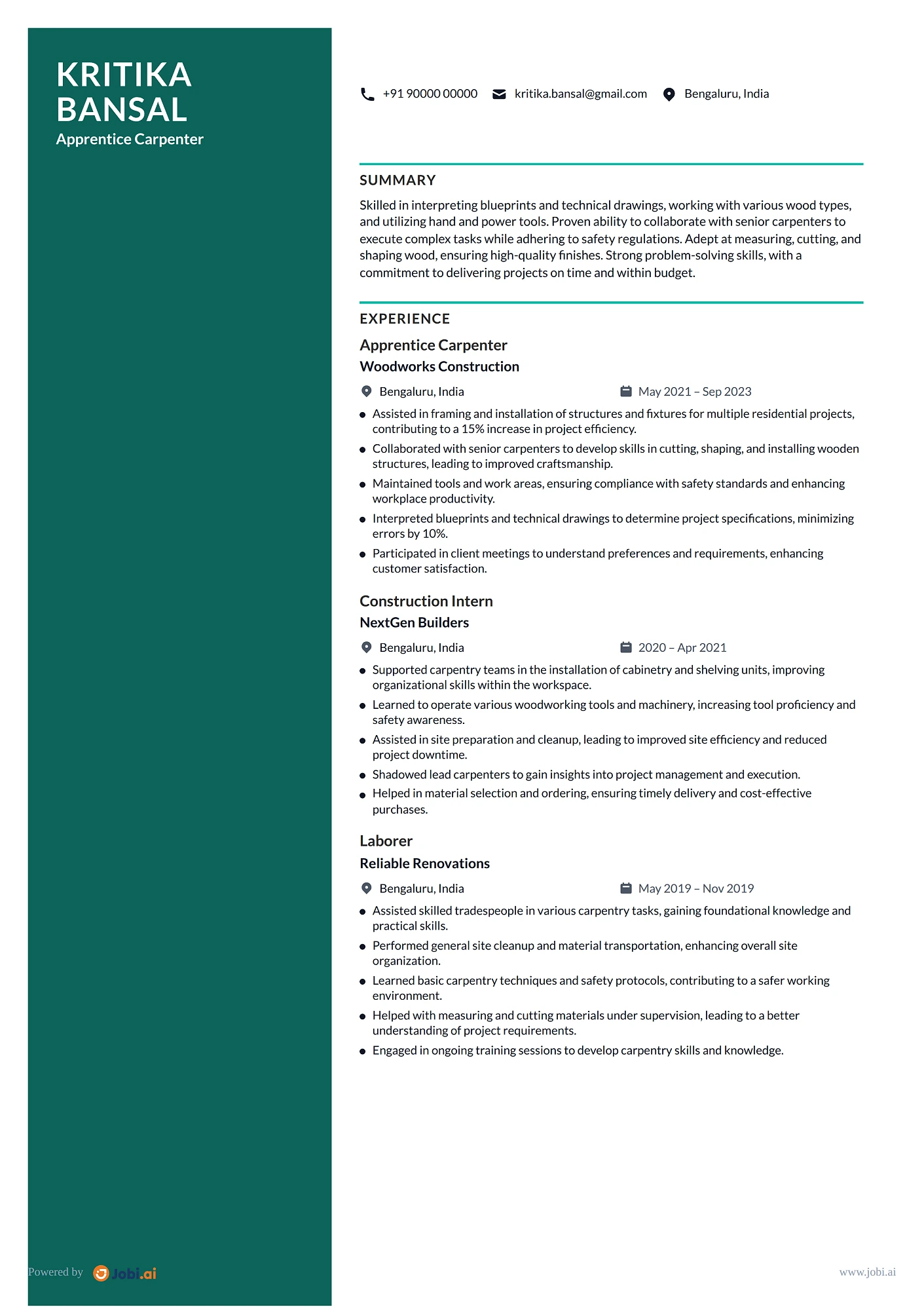
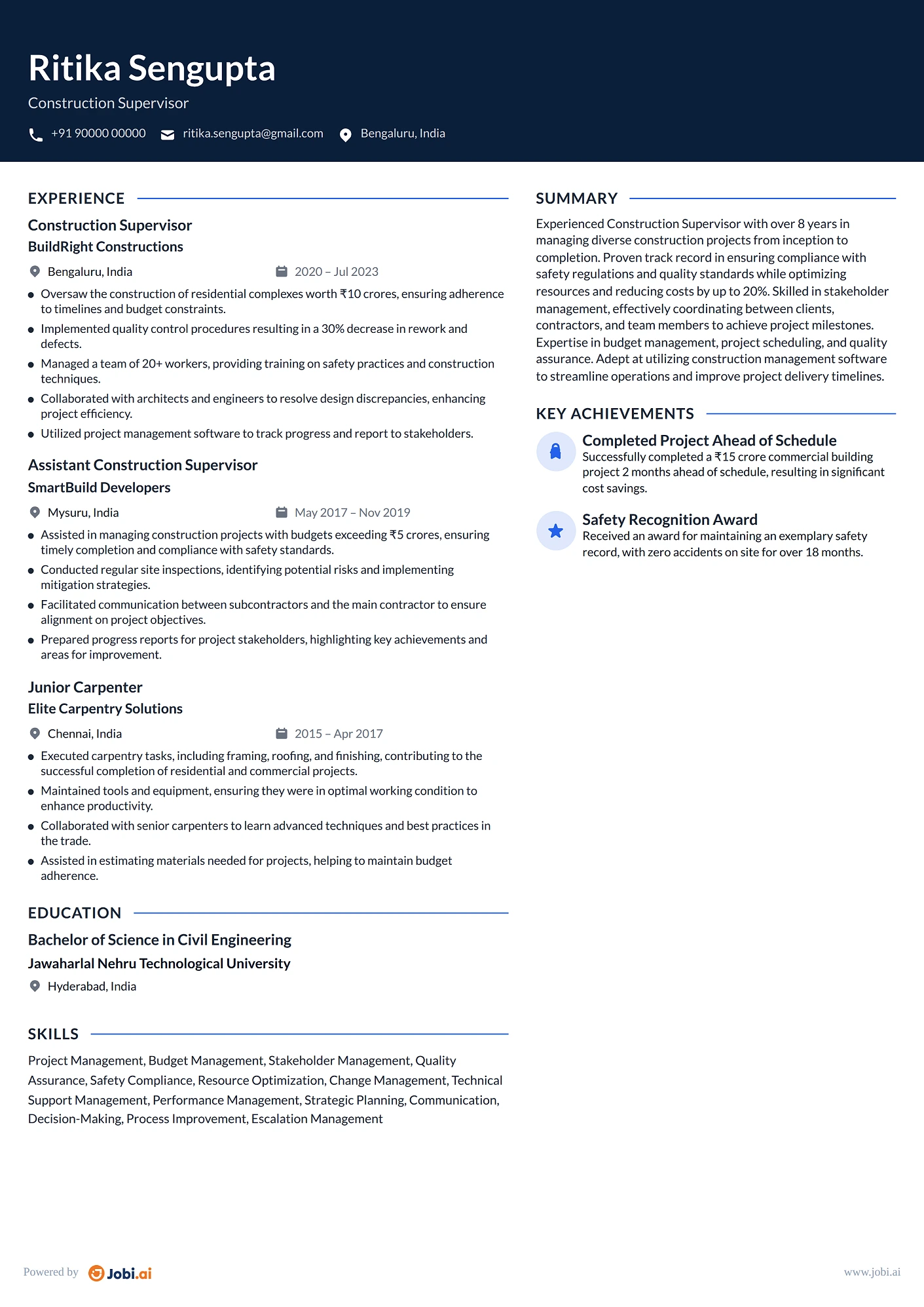
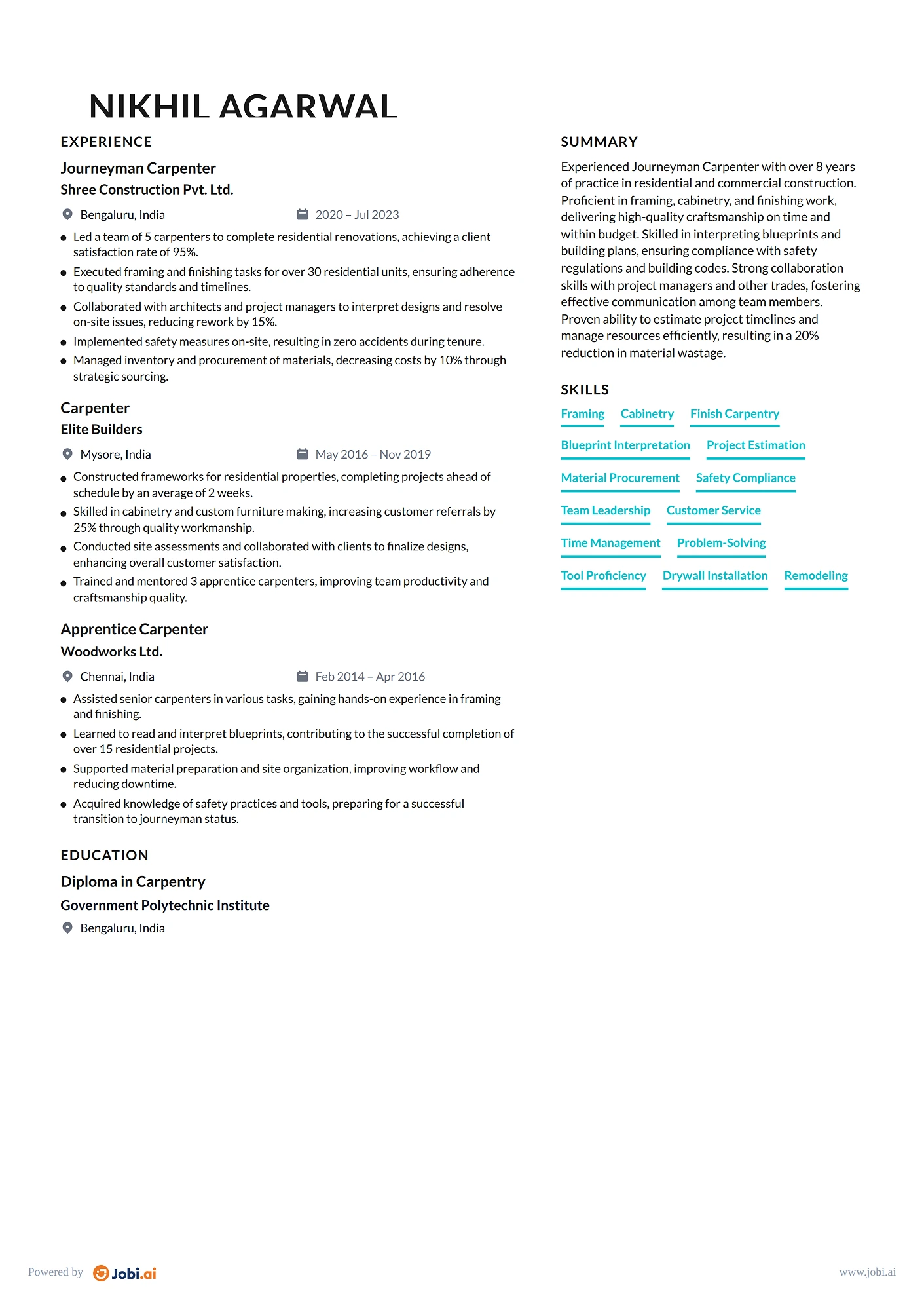
Real, rendered résumé examples — pick the closest match, open it in the builder, and swap in your own detail.
By seniority
For related roles
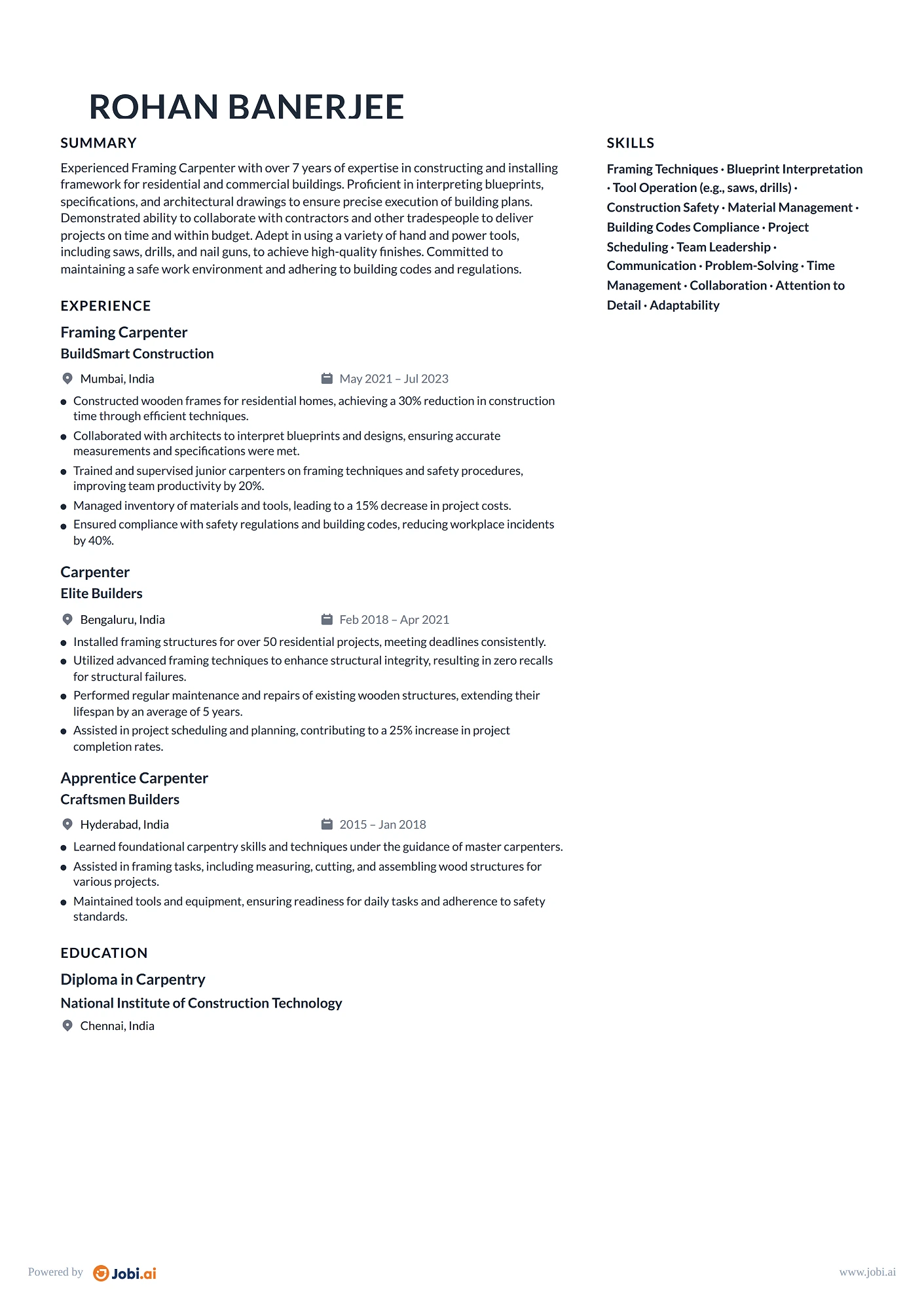
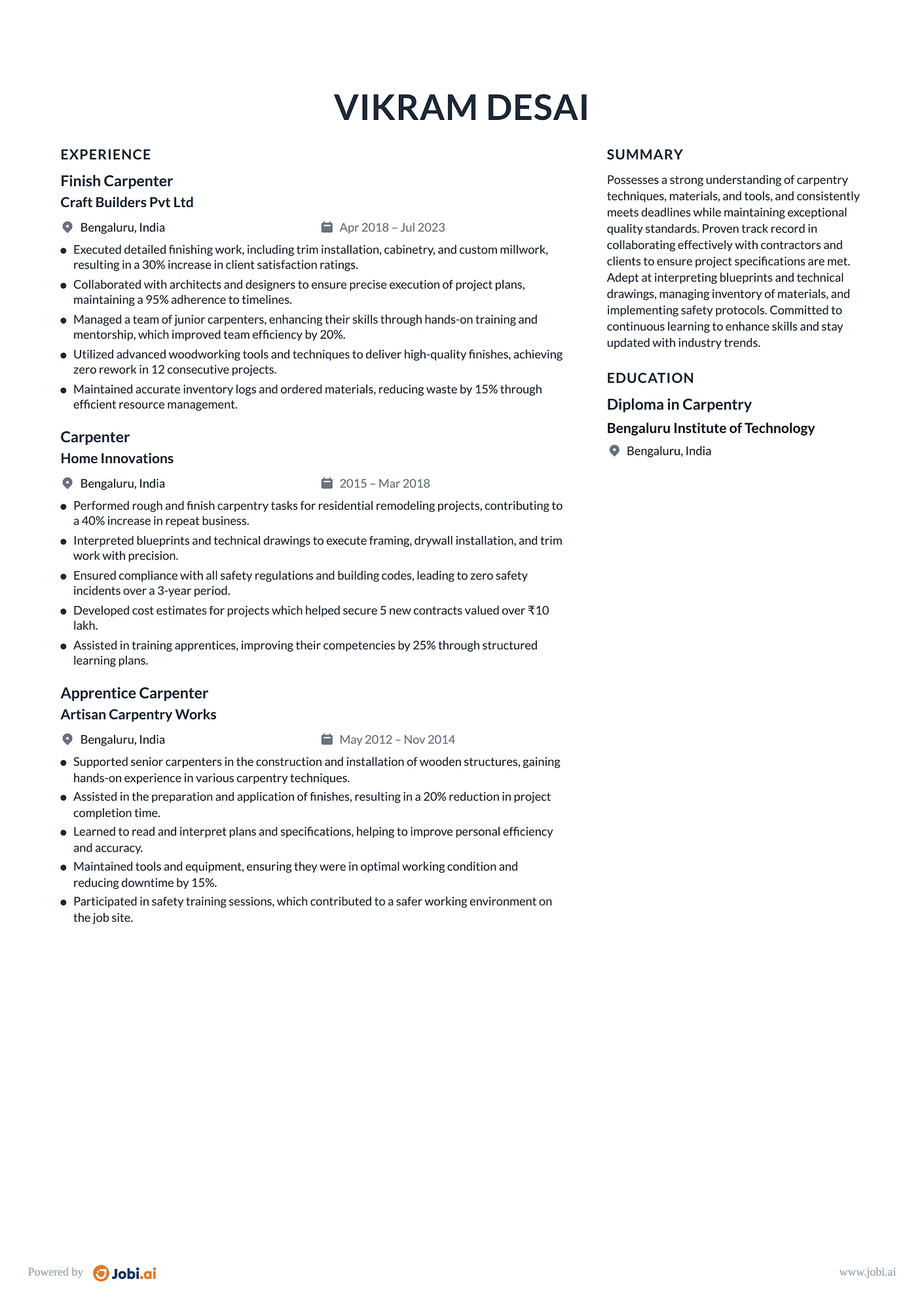
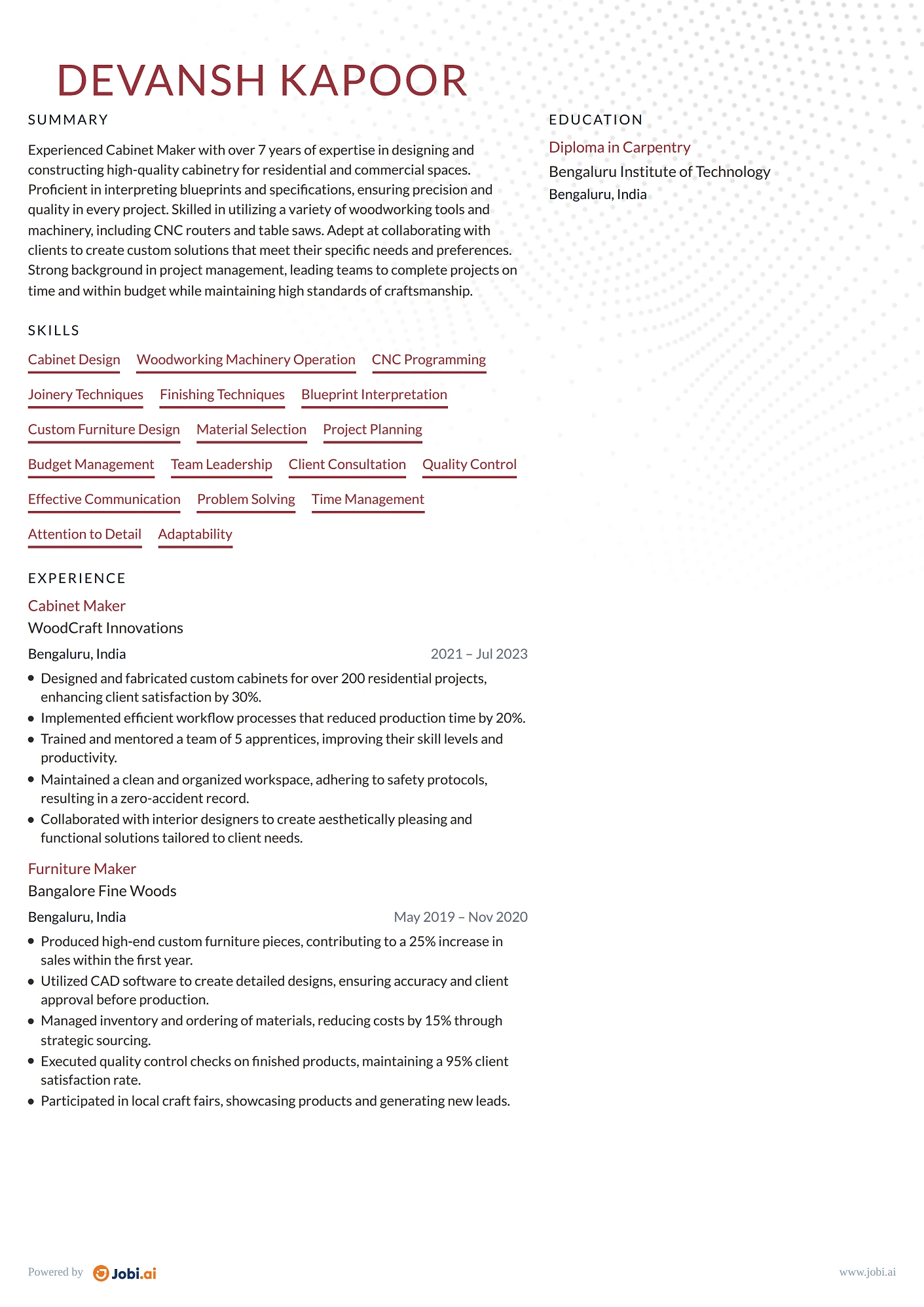
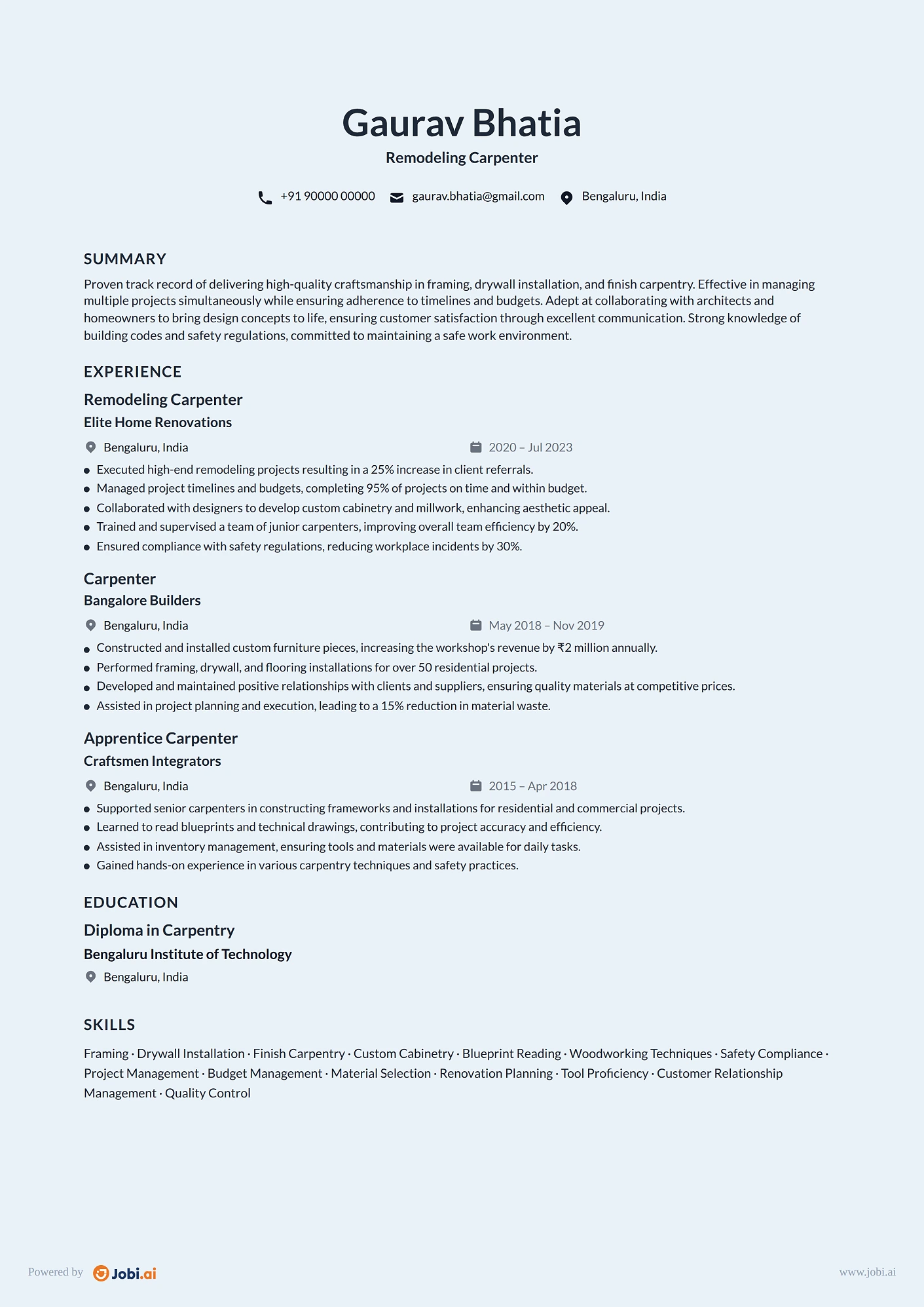
What to show at each level
Recruiters read seniority off the scope of what you own, not the tools you name. Match your bullets to the column you're targeting.
| Area | Junior | Mid | Senior | Lead / Staff |
|---|---|---|---|---|
| Technical Skills | Basic carpentry tools usage | Blueprint interpretation | Project management | Team leadership and training |
| Material Knowledge | Understanding of wood types | Knowledge of composite materials | Expertise in sustainable materials | Material sourcing and cost analysis |
| Safety Practices | Basic safety protocols | Advanced safety training | Safety program development | Safety compliance leadership |
| Project Management | Assisting in project planning | Managing small projects | Overseeing multiple projects | Strategic project planning and execution |
| Customer Interaction | Basic client communication | Client consultations | Negotiating contracts | Building long-term client relationships |
ATS keywords recruiters filter for
Include the must-haves you can honestly back up. An ATS matches exact terms, so mirror the wording of the role you apply to.
Must-have
Appear in the majority of Carpenter postings — cover these first.
Nice-to-have
Differentiators for senior and specialist roles.
The Carpenter toolchain, by category
Group tools by function on your resume — it reads faster than one long inventory.
- Chisels
- Hammers
- Saws
- Circular Saws
- Drills
- Nail Guns
- Tape Measures
- Squares
- Levels
- Hard Hats
- Safety Glasses
- Gloves
- CAD Software
- Project Management Tools
- Sanders
- Paint Sprayers
- Staining Equipment
How the resume changes by experience
Same structure, different emphasis. Lead with what's credible for where you are.
| Level | Lead with | Prove it with |
|---|---|---|
| Fresher | Basic knowledge of carpentry tools and techniques. | Completed a carpentry training program. |
| Junior | Assisted in carpentry projects under supervision. | Successfully completed small projects. |
| Mid | Independently managed carpentry tasks. | Delivered projects on time and within budget. |
| Senior | Led carpentry teams and complex projects. | Achieved high client satisfaction ratings. |
| Lead | Oversaw multiple carpentry projects and teams. | Implemented process improvements that increased efficiency. |
Writing guide
The decisions that matter, answered directly.
QWhat should I include in my Carpenter resume summary?›
QHow can I showcase my carpentry skills effectively?›
QWhat metrics should I include in my resume?›
QHow do I format my Carpenter resume?›
QWhat common mistakes should I avoid when writing my resume?›
Frequently asked
?What is the average salary for a Carpenter?›
?Do I need certifications to work as a Carpenter?›
?How can I improve my chances of getting hired as a Carpenter?›
Keep building your Carpenter resume
Tools and examples to take this from a draft to an application-ready resume.
Related roles
Build your Carpenter resume in minutes
Sign in to open this example, swap in your own metrics, and export an ATS-ready PDF.
✎ Sign in to edit this resume